
getting it wrong, never giving up
by Tim
October 15, 2026
The hidden benefits of publishing a debut novel in middle age.
It began at the dentist. I was in my late 40s and needed a bad tooth out of my face. My blood pressure was taken; the dentist absolutely refused to believe the result and requested a fresh device, only for it to confirm I was a walking dead man. It was like in a cartoon when the thermometer explodes. Later that same day, sitting at the GP’s, awaiting serious medication, I wondered: if my rotten tooth hadn’t saved me from dying, then, as a dead person, what would I have been really annoyed about not having done with my life?
These last thirty years I’ve had many lines of work — library assistant, touring musician, scriptwriter, comedy stooge. Throughout it all one story refused to leave my head, and now I had to accept it was a novel. Repeated kick-arounds of the project with Tanuja, my partner (and artistic partner-in-crime) all returned to the same conclusion: this wasn’t a short story, a dramatic monologue, an audio drama, no, it was a full-blown novel. I had a job to do. Even if no-one wanted me to do it.
This book I absolutely had to write was the story of Father Alberto, a young priest in late medieval times (sure, so far, so niche.) He takes on his first parish, in which there’s a strange annual tradition: on the drunken feast day of the Holy Fool, all the inmates of the local abbey’s ‘lunatic’ asylum are set free, to do whatever they want. The next morning it’s Alberto’s job to get them all back. But this exhausting task convinces Alberto there are better ways to care for these people, and he stumbles upon the foundations of psychiatric care. The problem being, no-one in authority wants him to stumble any further.
All I really had was the vivid final image of the book, and a geeky and somewhat gullible narrator. But my protagonist was also immune to any suggestion that he find a more sensible path in life, a more realistic calling. It took me an almost comical amount of time to realise how much this was a metaphor for being an artist.
I’m not a writer who decides their themes up front. I prefer them to emerge as I draft. Despite its historical setting my novel revealed itself as a story of the 21st century: it’s angry about the denigration of care in the modern world, spitting mad about the denial of human dignity to anyone who doesn’t have a stack of cash. Still, I was surprised at how much of myself was reflected in the book. As a writer or musician I can usually tell you what kind of feeling I’m trying to create for people. I’m far less successful at saying what product I’m aiming for. I believe the making and enjoyment of art requires a freedom of the soul. The capitalist demand that artists create products definable in advance is a yoke on that freedom.
Father Alberto, too, has no precise concept of where his work will take him. He only knows he wants the inmates in his care to have better lives. He keeps attempting different methods, getting it wrong. He confesses his pride but keeps going, even when ordered to stop, even when the inmates themselves resist. The most persistent of his troubles is the asylum’s youngest inhabitant, a girl who speaks an unidentifiable language and believes she’s able to fly. When set free on feast day she evades Alberto at every turn, in what I took to describing as a medieval version of Wile E. Coyote and Road Runner. The girl’s escapades become more and more dangerous, with increasing peril to Alberto’s person.
George Orwell said any life viewed from the inside will always be seen as a series of defeats. My life’s exactly that, except also from the outside. I’ve had this slapstick obstacle course of a career that includes landing a massive record deal then losing it remarkably fast, or winning a high-profile playwriting award on the fifth attempt only for covid-19 to scupper any production of the play (so far). The hits keep on coming, without any actual hits.
However. There are wonderful gifts from my under-the-radar artistic life. I’ve spent it in the company of similarly under-the-radar artists whose work is of astonishing quality, unconcerned with ‘product’, preferring to follow their instincts and beliefs. They’ve been the best school I could possibly have, and this novel I’ve written could not have existed without them. I’ve played gigs with bands whose music has ignited room after room, only for their albums to sink without trace. I’ve spent hours talking to performance artists who have given every last ounce of their energy to elaborate time-consuming productions, artworks I’ll never be able forget yet I’m one of only fifty people who stood as witness. None of it has truly felt like failure, rather a shared progress, made in the moment. Meaning: in my advancing age I fully understand the importance of community to any artwork, and when I don’t have parts of that community available to me, I know I have to find them.
So once I realised, with alarm, I was about to write a novel, that’s what I did. I found the first Arvon Foundation retreat available and spent a fantastic five days with fellow authors and two amazing tutors – Rachel Seiffert, Chris Wakling – who pushed me to finish the book in a few months. Two years later, with the manuscript in the wilderness, Rachel helped Father Alberto and the Flying Girl get into the hands of a publisher. The key thing all those conversations and kicks-up-the-arse gave me was permission: even after a lifetime of creativity I still need permission to think the work good enough, strong enough. When authors receive advice on product alone they’re hearing the sound of career panic, of mortality. I needed better voices in my ear. Voices that were louder than death.
I fully understand this represents an oasis of privilege. We don’t teach this way of being an artist any more, of progress based on honest instincts, allowing for failures — not really, not with conviction. Younger generations are currently growing up without their own permissions. Somewhere between our schools and universities cutting arts subjects, streamers denying musicians fair pay, the life work of authors being scraped for automated profit, and the underfunding of our theatres and libraries to the point of collapse, we’ve stopped investing in creativity as a way of life. We keep on talking about art as GDP, not as a site of human freedom. All that an ageing artist like me has left is friends, and yes, I got lucky.
In the novel Father Alberto imagines his life being illuminated like a medieval manuscript, his deeds and learning laid out in filigree lettering amidst immaculate illustrations. As he describes these drawings he’s pedantic about how they should be presented; a true artist. I’ll confess to a similar pride that this book is being put into the world by a storied publisher, but in some ways I’m prouder of the journey that led to it. Business practice or economics are happily taught as stubbornness, strength, vision, and yet we treat art as embellishment, as luxury, when really it’s an essential pillar of health, the one place in life where humans are free to create their own meaning. Being a small voice in the dark is part of this beauty; having your voice amplified, celebrated, is just another possible outcome. So Father Alberto and the Flying Girl has ended up being about that, too: honesty in obscurity can be a victory; ambition is one thing, legacy another.
Back in 2012 my younger brother Mike died suddenly at the age of 35, of a very rare heart condition, undiagnosed up until the night he went. He was a creative technologist at a secondary school. He was also, quietly and enthusiastically, one of the best drummers I’ve ever seen. Mikey played with skill, flair, with all his heart. His drumming made him happy, and it made other people happy.
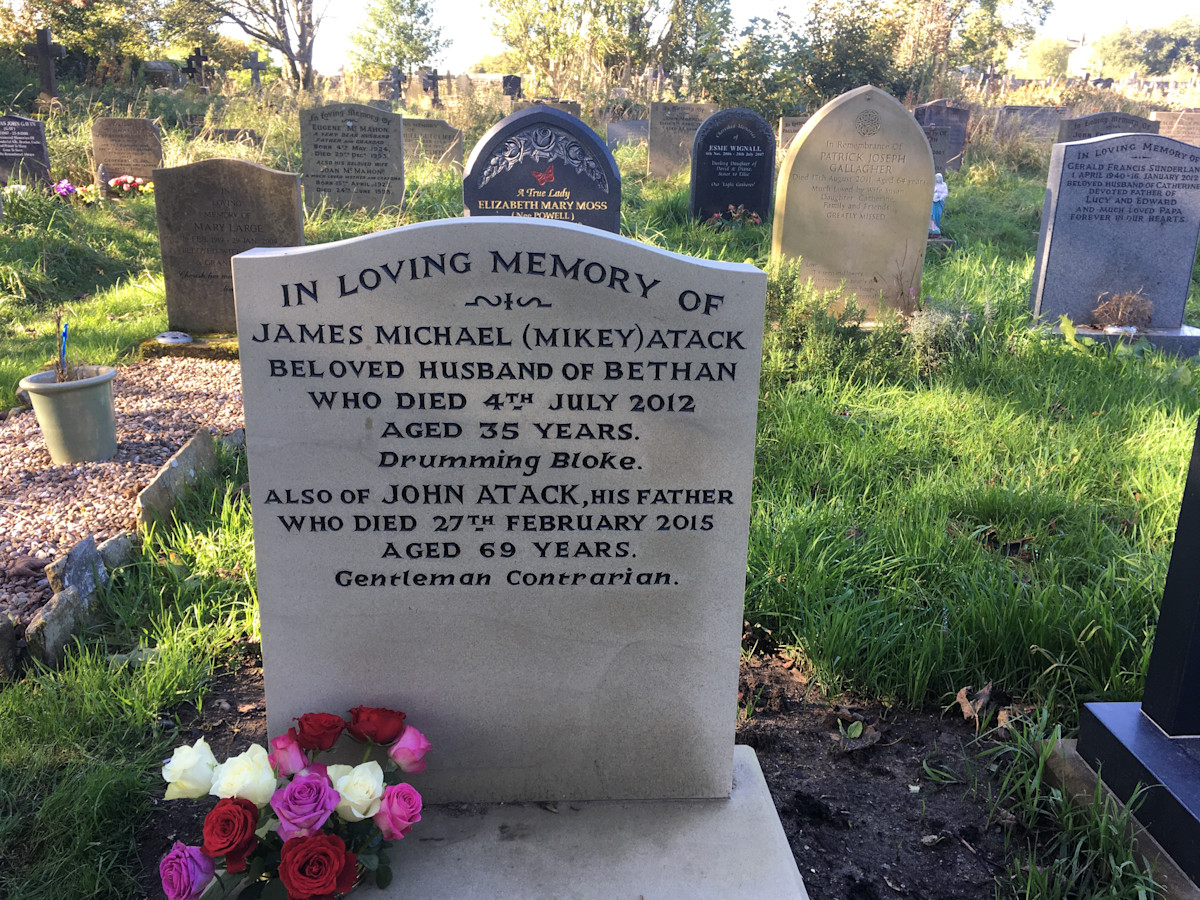
Alongside my late father, Mike’s remains are interred in a Yorkshire churchyard that is also home to the resting place of Sylvia Plath. Lives cut short, ending sadly –– but honest and questing artists, both. If you’re paying a visit to Sylvia and fancy saying hi to my brother, you can’t miss him: the inscription on his gravestone says Drumming Bloke. I once found myself contemplating that epitaph then looking over to the other side of the cemetery, at Sylvia Plath’s headstone, adorned with tributes as it always is… and I wondered which kind of artist’s legacy I’d prefer, come the end. I’m now really happy to say: I haven’t the slightest preference. My brother – among many other brilliant people – has taught me ambition and legacy are two very different things. The voice in my head is louder than death.
So to anyone in later life looking at their rising blood pressure and thinking of writing their long-deferred book, wondering whether they deserve their illuminations, all I can say is:
1. Do it.
2. Do it truthfully, and
3. Never give up.